Homeostasis
Homeostasis is the tendency of biological systems to maintain relatively constant internal conditions while adapting to internal and external changes. It is not the same as equilibrium — the body actively works to hold conditions steady.
Feedback loops
A feedback loop controls the level of a variable using four elements:
- Variables: the parameters being monitored and controlled.
- Receptors (sensors): detect changes in the variable.
- Control centers (integrators): compare the variable to a set point and signal a response.
- Effectors: carry out the change.
- Communication: signals travel via nerves or hormones.
A feedback cycle is any situation where a variable is regulated and its current level influences the direction it changes.
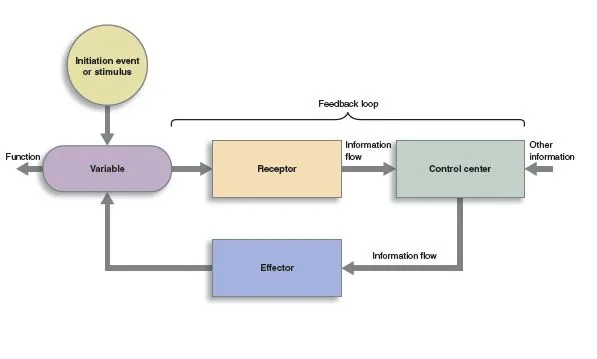 Figure: Components of a feedback loop. Credit: Lumen Learning / OpenStax, CC BY 4.0.
Negative feedback
A change in one direction causes a change in the opposite direction, promoting stability.
- Temperature drops: the hypothalamus triggers vasoconstriction, shivering, and metabolism-boosting hormones.
- Temperature rises: the hypothalamus triggers vasodilation and sweating.
Positive feedback
A change in one direction causes additional change in the same direction (amplification). It is useful when limited — examples include labor and lactation — but harmful when uncontrolled, as in hemorrhagic shock.
Blood glucose example
Insulin works through negative feedback: glucose rises after eating, beta cells release insulin, cells absorb glucose, levels fall, and insulin release stops.