Core terms
- Feedback loop: a system to control a variable, made of an identifiable receptor (sensor), control center (integrator/comparator), effectors, and methods of communication.
- Variable: a parameter that is monitored and controlled by the feedback system (e.g., temperature, blood glucose, calcium).
- Receptor (sensor): detects changes in the variable being monitored.
- Control center (integrator): compares the variable to a set point and signals the effectors to respond. It can also weigh other factors such as time of day, age, and external conditions.
- Set point: the target value the control center compares against (like the desired temperature on a thermostat).
- Effector: carries out the change that adjusts the variable back toward the set point.
- Methods of communication: nerves or hormones let the components signal one another. Sometimes the receptor and control center are the same structure.
- Feedback cycle: any situation where a variable is regulated and its level affects the direction in which it changes.
Temperature regulation example
- Thermoreceptors detect temperature changes in internal organs and skin and send signals to the hypothalamus.
- The hypothalamus is the control center for temperature regulation.
- Effectors for low temperature: blood vessels near the skin constrict to reduce heat loss, and skeletal muscles contract (shivering) to generate heat.
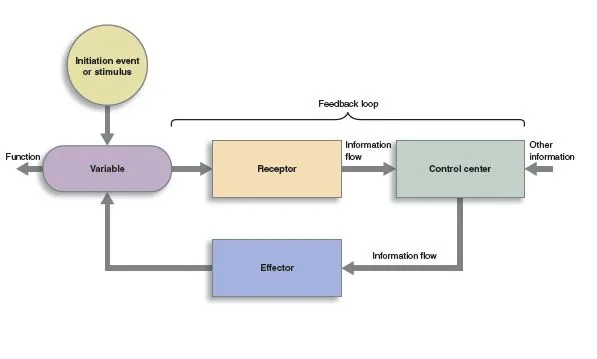 Figure: Feedback loop terminology. Credit: Lumen Learning / OpenStax, CC BY 4.0.