What is homeostasis?
Homeostasis is the body’s ability to maintain relatively stable internal conditions even when the outside world changes. The body monitors many physiological values and resists significant deviations from their normal ranges.
- Set point: the ideal value around which a variable normally fluctuates.
- Normal range: the small band of values above and below the set point that the body tolerates.
How the body holds steady
Most homeostatic control relies on negative feedback, which reverses a change once a variable moves outside its normal range. A feedback system has three core parts:
- Receptor (sensor): monitors a physiological value and detects change.
- Control center: compares the value to the normal range and decides on a response.
- Effector: carries out the action that reverses the change.
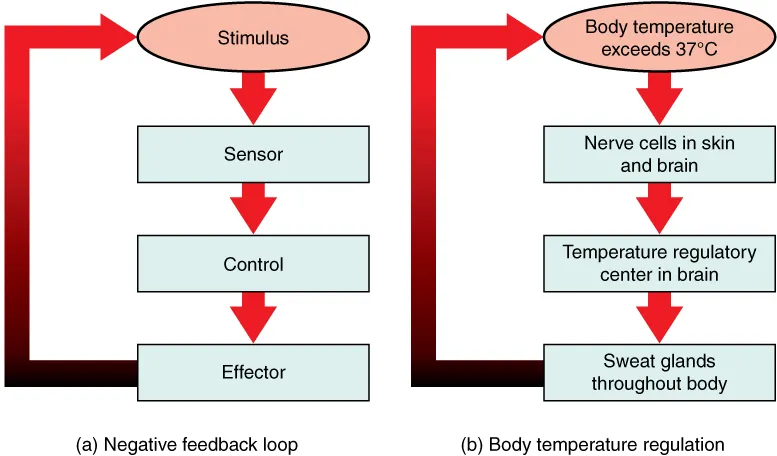 Figure: Negative feedback loop (body temperature). Credit: Lumen Learning / OpenStax, CC BY 4.0.
Examples
- Body temperature: when too hot, the body sweats, dilates blood vessels, and breathes faster to lose heat; when too cold, it shivers and releases hormones to generate heat.
- Blood glucose: insulin lowers blood sugar after a meal.
Positive feedback
A few processes use positive feedback, which intensifies a change rather than reversing it. The body uses it sparingly for events that must finish quickly, such as childbirth (oxytocin and uterine contractions) and blood clotting.
Why it matters
When feedback systems fail, variables drift out of range and disease can follow — for example, Type 1 and Type 2 diabetes result from failures in blood-glucose control.