Overview
Maintaining homeostasis is essential for proper physiological function. The body uses feedback systems at many levels of organization, and dysfunction can lead to disease or death.
Calcium ion homeostasis
The endocrine system regulates blood calcium via the parathyroid and thyroid glands:
- Low calcium: parathyroid hormone makes kidneys retain calcium and osteoclasts release calcium from bone.
- High calcium: calcitonin (active in children) prevents bone breakdown and increases urinary calcium loss.
- Imbalances: hypocalcemia → muscle spasms and heart malfunction; hypercalcemia → muscle weakness, heart problems, and kidney stones.
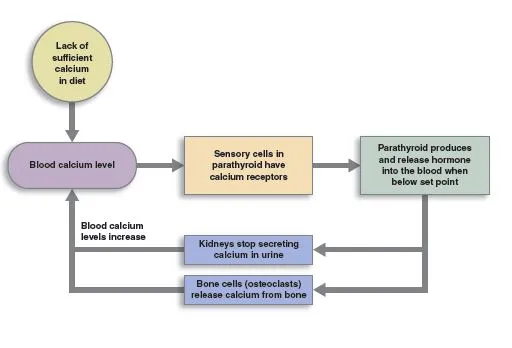 Figure: Blood calcium negative feedback loop. Credit: Lumen Learning / OpenStax, CC BY 4.0.
Glucose homeostasis
The pancreas and liver regulate blood glucose:
- Elevated glucose: insulin lets cells take up glucose for energy; the liver stores excess as glycogen.
- Decreased glucose: glucagon stimulates the liver to break down glycogen, releasing glucose into the blood.
Cell number regulation
Cells maintain appropriate tissue density through negative feedback using cell-to-cell communication and nutrient sensing:
- Excess cells undergo apoptosis (programmed cell death).
- Depleted populations receive signals to divide.